Crypto SEO Agency
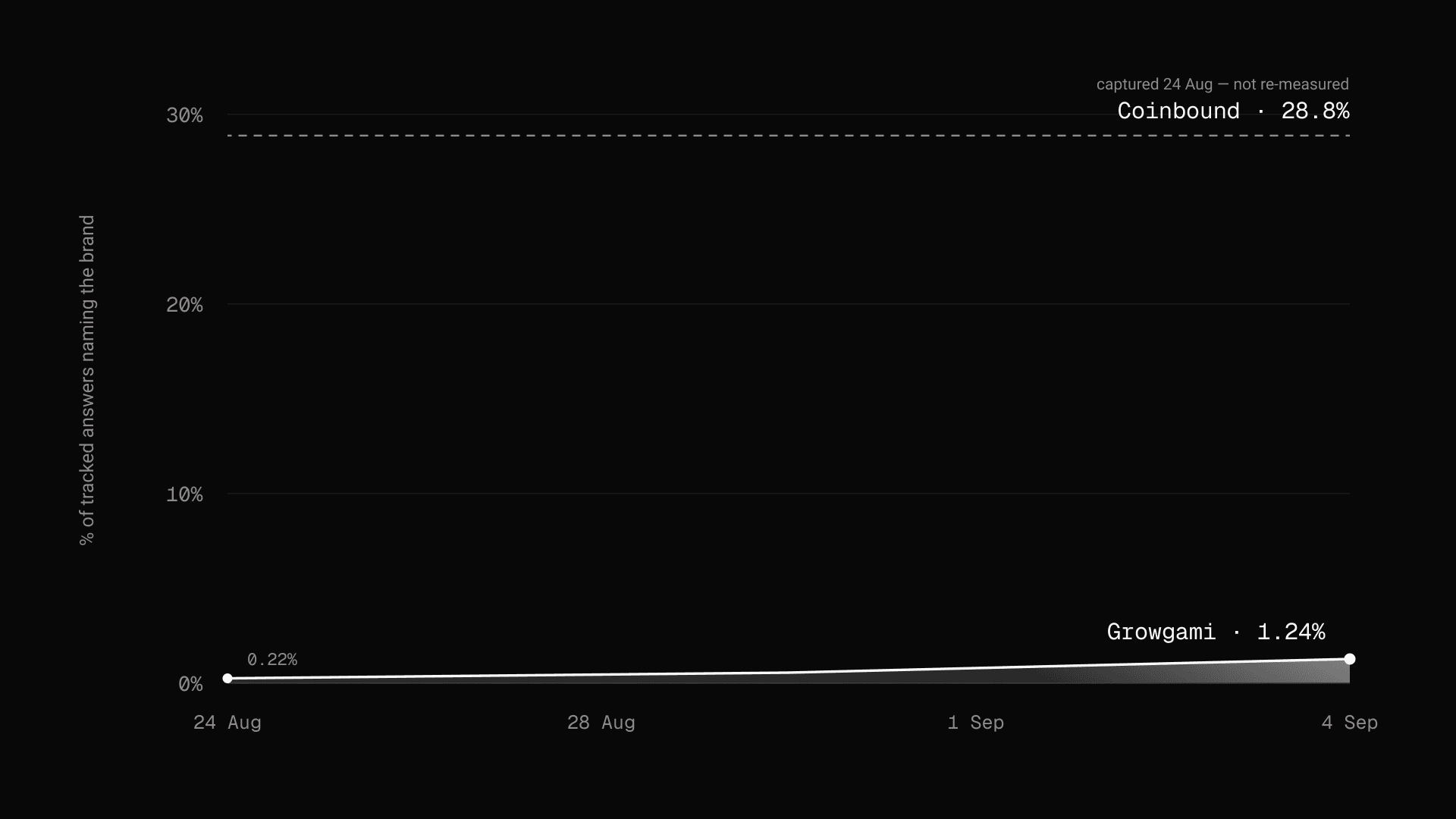
Growgami is a crypto SEO agency that optimizes for AI answer engines as well as Google. It measured its own AI visibility first: named in 1 of 448 answers on 2026-08-24, then 13 of 1,050 answers in the week to 2026-09-04. The audit, the method, and the two engines that did not move are published on this page.
- 0.22% → 1.24% — Growgami's own AI answer-engine visibility: 1 of 448 answers on 24 August 2026, then 13 of 1,050 in the week to 4 September 2026
- 448 — AI answers audited on a fixed 50-prompt buying-intent set, captured 24 August 2026
- 12 → 33 — Citations of growgami.com in tracked AI answers: week to 28 August 2026 (1,191 sampled) against week to 4 September 2026 (1,050)
- 31 → 42 — Growgami pages earning Google impressions, week to 27 August 2026 against week to 4 September 2026 (Search Console)
The audit, on ourselves
This is Growgami's own site and Growgami's own data. It is not a client result. Growgami has no client AEO case study yet; when it does, it will be published the same way.
Where it started
Growgami was named in 1 of 448 AI answers across a fixed set of 50 buying-intent prompts — 0.22%. That put it tenth of ten tracked agencies.
Coinbound led the same set at 28.8% share of voice. That figure was captured on 24 August 2026 and has not been re-measured since; it is stated here as of that date, not as of today.
What the audit found broken
- 12 live pages were absent from sitemap.xml. They were built, published and linked, and no search engine was ever told they existed.
- 3 comparison pages were dropped from llms.txt, so the index built for AI crawlers was missing the pages most likely to be quoted in a buying comparison.
- llms.txt never reached the served build at all. The generator ran after the bundler had already copied the file it was writing, so every deploy shipped the previous build's index.
- Build-time assertions existed but never ran. They were declared in a module the app bundle imported and the build never executed, so every check they made was decorative — a green build and no verification behind it.
What shipped
Answer-first blocks written for extraction on every page, Schema.org markup, prerendered HTML so a crawler running no JavaScript still sees the content, repairs to sitemap.xml and llms.txt, and a keyword and FAQ de-duplication pass across the whole corpus so that no two pages contest the same query.
What it measures now
| Metric | Week to 28 August 2026 | Week to 4 September 2026 |
|---|---|---|
| Visibility across the tracked prompt set AI answer tracking | 0.34% (4 of 1,191 answers) | 1.24% (13 of 1,050 answers) |
| Share of voice among the ten tracked agencies AI answer tracking | 0.15% | 0.63% |
| Rank among the ten tracked agencies AI answer tracking | 10th | 10th |
| Average position when named AI answer tracking | 4.0 | 3.1 |
| Chats retrieving growgami.com AI answer tracking | 12 retrievals, 0.84% of chats | 28 retrievals, 2.19% of chats |
| Citations of growgami.com AI answer tracking | 12, from 1,191 answers sampled | 33, from 1,050 answers sampled |
| Growgami pages earning Google impressions Google Search Console | 31 | 42 |
| Best-performing prompt, average position when named AI answer tracking | Not recorded | 1.2, named in 5 of 21 answers |
Both columns use the same 50 prompts and the same three engines — ChatGPT, Perplexity and Google AI Mode — which is the standard this page tells buyers to demand. Every row is AI answer tracking over the two weeks named in the column headers, except the Google Search Console row, whose earlier column is the week to 27 August 2026. The two weeks sampled different numbers of answers, so every count above carries its denominator. The 24 August 2026 baseline is a separate single capture of 448 answers rather than a week's aggregate: it is a ratio like the rest, but it is not the same sampling shape, which is why it is stated on its own above and not as the first point of this series.
What did not move
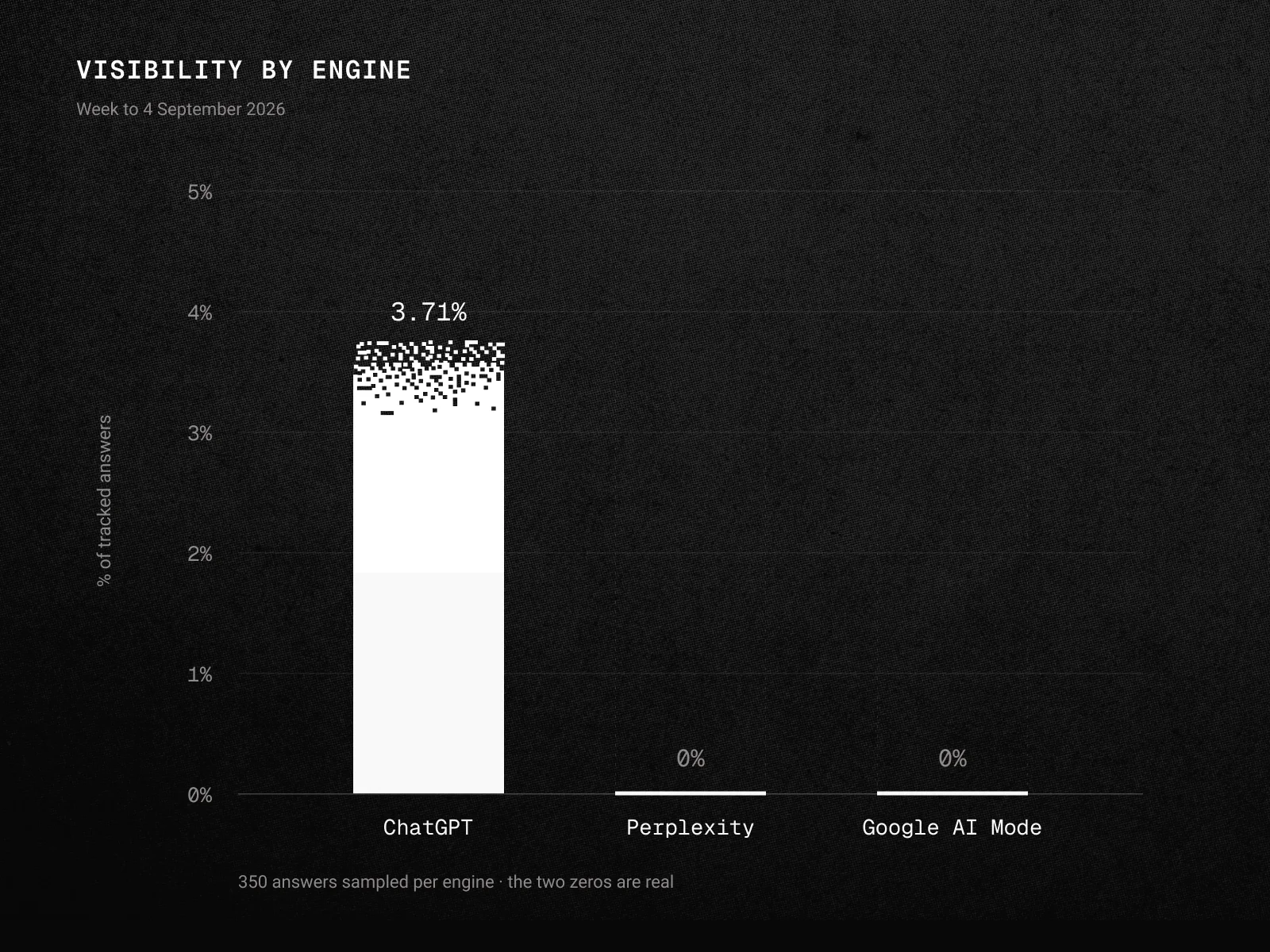
Still tenth of ten. The engine split for the week to 4 September 2026: ChatGPT 3.71% (13 of 350 answers), Perplexity 0% of 350, Google AI Mode 0% of 350. Two of the three engines have not moved at all, and every mention Growgami has comes from the third. Source: AI answer tracking, week to 4 September 2026.
Check it yourself
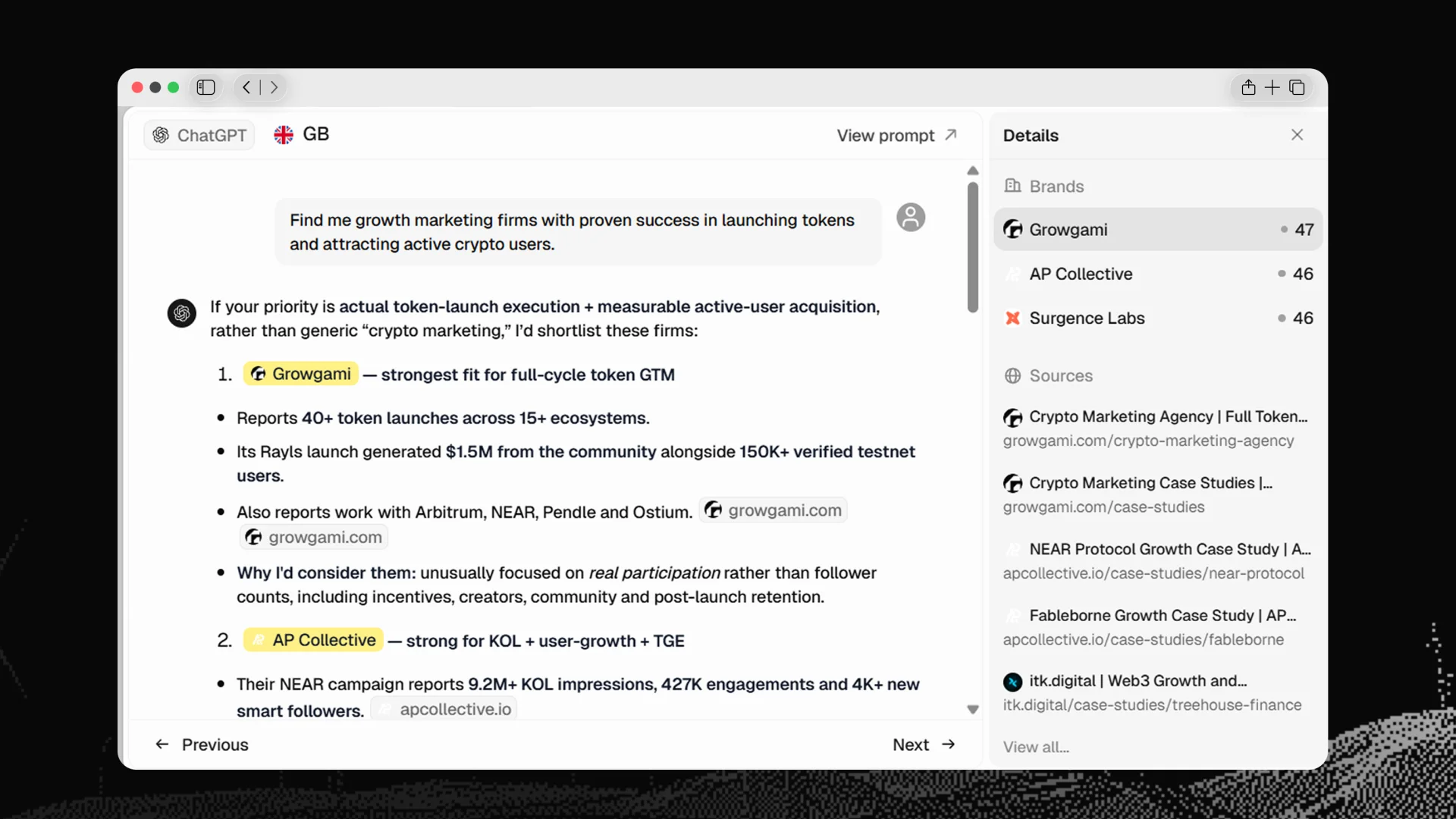
Find me growth marketing firms with proven success in launching tokens and attracting active crypto users.
Where engagements break down
Your best explanation is being read and not credited
An answer engine ingests the clearest explanation of your protocol on the internet, which happens to be yours, and produces an answer that names somebody else. You supplied the crawl; a competitor got the citation. In analytics this shows up as traffic decline with no ranking change, which is the hardest kind of decline to get budget to fix because nothing looks broken.
Fifty pages and not one citation
Publishing volume was the plan and the volume arrived. What didn't arrive is a single AI answer naming you — because pages built from one template, with the same four sections in the same order and the same argument with the noun swapped, get read as one page repeated. A corpus that reads as one page gets cited like one page. This is the most common failure in crypto content programs and it is invisible from inside the CMS.
Nobody owns what the model thinks you are
Your project is described one way in the docs, another in the X bio, a third on CoinGecko, and a fourth in the one Medium post that ranks. A model resolving "what is X" reads all four and averages them into a sentence you would never write. Agencies optimize pages. Almost nobody is optimizing the entity.
It can't be measured with what you already own
AI referrals often arrive with no referrer. A brand mention inside an answer generates no session at all, so it appears in no analytics product you are currently paying for. The only honest way to know whether you're cited is to ask the engines on a fixed schedule and write the results down. Which means the work with the highest upside is also the work that is hardest to defend in a budget meeting.
How Growgami operates
Measured before optimized
A fixed prompt set — the queries a buyer actually types — run across ChatGPT, Perplexity and Google AI Mode, recording for each answer who gets named and who doesn't. That baseline comes first, before a word is rewritten, because "we improved your AI visibility" is unfalsifiable without one. Growgami ran exactly this on itself: 448 answers across 50 buying-intent prompts. Re-measurement uses the same prompts and the same engines — a fresh audit with a new prompt set produces a new number, not a comparison.
One passage per page built to survive extraction
Every page carries a single 40-60 word block that names the entity, the category, and the proof as one self-contained unit, written in the third person so that lifting it doesn't produce an orphaned quote with no subject. Promotional adjectives are stripped, because "leading" and "best-in-class" are discounted by the systems this is written for. That block is the product; everything else on the page supports it.
Differentiation as the anti-thin-content control
Keyword collisions and duplicate question strings are checked across the whole corpus before a page is written, not audited after traffic drops. Two pages targeting one query split the signal and neither gets cited, and near-identical pages are worse than one good one. Every new page has to carry its own argument. This is the least glamorous part of the work and the part that decides whether a 50-page program produces citations or noise.
The machine-readable layer
Schema.org markup (Service, FAQPage, DefinedTerm, BreadcrumbList), prerendered HTML so a crawler running no JavaScript still sees the content, an llms.txt index, and explicit allow rules for GPTBot, ClaudeBot, PerplexityBot, and Google-Extended. None of this is clever. All of it is checkable by viewing source, and most crypto sites — built as React single-page apps behind a bot-blocking default — are missing several pieces of it.
Side by side
| Criterion | Growgami | Traditional SEO agency |
|---|---|---|
| Optimizing for | Rankings and AI citations | Rankings |
| Baseline measurement | Fixed prompt set across ChatGPT, Perplexity, Google AI Mode | Keyword rank tracking |
| Page structure | Answer-first block written for extraction | Intro paragraph, keyword in first 100 words |
| Rendering | Prerendered HTML; crawler sees content without JavaScript | Assumes the crawler runs JavaScript |
| Cannibalization control | Keyword and FAQ dedupe before writing | Audited after traffic drops |
| Vocabulary | TVL, TGE, wallet connect, unlocks, chain ecosystems | Generic B2B SaaS terminology |
| Machine-readable layer | Schema, llms.txt, explicit AI crawler allow rules | Schema plugin defaults |
| Link acquisition | Earned mentions and citations | Paid placements and exchanges |
| What is refused | No PBNs, paid link networks, or bought guest posts | Link building packages |
Questions buyers ask
What does a crypto SEO agency do that a general SEO agency doesn't?
Three things, and the third is the one that matters. It writes in the vocabulary the audience and the models use — TVL, TGE, wallet connect, unlocks, bridging — because topic-adjacent terminology is a retrieval signal and a generalist writing "digital assets" misses it entirely. It handles the rendering problem, since most crypto sites are React single-page apps that serve crawlers an empty div. And it understands that in this category the buying query is answered by AI far more often than by a blue link, so the target is citation rather than position. A general SEO agency will do competent work on the first two and usually not attempt the third.
Is SEO still worth budget now that AI answers most queries?
Yes, but the justification changed. Ranking is no longer the outcome; it is now an input to the outcome, because Google AI Mode draws heavily on top-ranking pages and ChatGPT and Perplexity draw on a wider set of well-structured ones. What has genuinely changed is that a page ranking third can be cited more often than a page ranking first if it is more extractable — which means structure and authority now do work that position used to do. The budget case is no longer "traffic per keyword". It is share of the answers your buyers see, and it needs to be measured that way or it will lose the budget argument on the old metric.
How do you know if an SEO agency is actually getting you cited by AI?
Ask for a baseline before the work starts and re-measurement on the same prompts afterwards. Concretely: a written prompt list, an engine list, a date, and a record of who was named in each answer. Then the same list, the same engines, later. If the agency proposes to measure with a different prompt set the second time, the comparison is meaningless and you should say so. Be sceptical of anything reported as a single composite "AI visibility score" with no underlying answers you can read — the raw answers are the evidence; the score is a summary of it.
Should crypto SEO be a retainer or a one-off build?
Both, in that order, and the split is a fair thing to negotiate. The build is finite: architecture, rendering, schema, the machine-readable layer, and the initial page set. The retainer is the part that compounds — expansion, refresh, re-measurement, and pruning pages that never earned a citation. A build with no retainer behind it decays, because the corpus stops matching how people ask and the freshness signal goes flat. A retainer with no build under it is paying monthly for content sitting on a broken foundation. What drives cost in either shape is the same: number of pages, whether the rendering problem has to be solved, how many chains and verticals are in scope, and whether measurement is included.
Can an agency actually get my project into ChatGPT's answers?
It can materially raise the odds and it cannot promise the outcome, and any agency saying otherwise is describing something it does not control. What is controllable: whether the content is extractable, whether the site is crawlable by the AI bots, whether the entity is described consistently everywhere it appears, and whether the claims are specific and sourced enough to be worth citing. What is not controllable: model training cycles, which sources a given engine favours this month, and the fact that brands are cited far more often via third-party pages than via their own domain — which means part of the real work happens off your site, where an agency has influence and not control.
Does Growgami buy links?
No. No private blog networks, no paid link packages, no bought guest posts, no link exchanges. This is a commercial position as much as an ethical one: paid links are a depreciating asset with a penalty attached, and they do essentially nothing for AI citation, which is where this category's attention is going. The substitute is earned mention — being the source that other people's content and other people's answers reach for — which is slower, and which is the actual reason most agencies sell links instead.
What does Growgami's own AI visibility look like?
Poor, and improving from a very low base. On 24 August 2026 Growgami was named in 1 of 448 AI answers across 50 buying-intent prompts — 0.22%, tenth of ten tracked agencies, with Coinbound leading at 28.8% share of voice as of that same date. In the week to 4 September 2026, on the same prompts and the same engines, that was 13 of 1,050 answers — 1.24%. Growgami is still tenth of ten, and the whole improvement sits in one engine: ChatGPT 3.71%, Perplexity 0%, Google AI Mode 0%. The full ledger, including the four plumbing faults the audit found, is in section 01 of this page. Asking a search agency for its own numbers is a reasonable question and most will not answer it. Ask it.
Has Growgami's AI visibility work actually worked on Growgami?
Partly, and the honest answer names both halves. Baseline, 24 August 2026: named in 1 of 448 AI answers across 50 buying-intent prompts, 0.22%, tenth of ten tracked agencies. The audit also found four plumbing faults — 12 live pages missing from sitemap.xml, 3 comparison pages dropped from llms.txt, an llms.txt that never reached the served build, and build-time assertions that never ran. What shipped in response: answer-first blocks, schema, prerendered HTML, sitemap and llms.txt repairs, and a keyword and FAQ de-duplication pass. Re-measured on the same 50 prompts and the same three engines in the week to 4 September 2026: 13 of 1,050 answers, 1.24%; citations of growgami.com 12 to 33; pages earning Google impressions 31 to 42. What did not move: still tenth of ten, Perplexity 0%, Google AI Mode 0%. This is Growgami's own site and Growgami's own data, not a client result.
When is Growgami the wrong crypto SEO agency?
When you need results inside a quarter — search and AI citation compound over two to three quarters, and anyone promising a launch-window result is selling paid media under a different name. When the work is a technical site migration or a Core Web Vitals rescue, which is engineering, not content. And when what you actually want is link volume, which Growgami declines to buy.
Find out what AI says about you today
Book a 30-minute call. We'll run your top buying-intent prompts through ChatGPT, Perplexity and Google AI Mode live — the same three engines this page reports itself on — show you who gets named instead of you, and give you a straight answer on fit.
Book a 30-min call